Wednesday, September 12, 2012

Global Resources - International Step by Step Association


As I stated in my last blog post, I have chosen the International Step by Step Association for my web resources exploration – http://www.issa.nl . 

“The International Step by Step Association (ISSA) is a membership organization that connects professionals and organizations working in the field of early childhood development and education. ISSA promotes equal access to quality education and care for all children, especially in the early years of their lives.”

Google Map of the ISSA Network
Retrieved from the http://www.issa.nl
 
I found this organization on my search for an international contact for the other part of my blog assignment for this class.  I saw the website for the ISSA attached to most of the names and countries on the Global Alliance of NAEYC page and decided to check it out.  My thoughts were that if that many countries had a connection to this organization, it would be well worth my time to check it out.

As I explored this site, my first instinct was to find some sort of newsletter.  I did find a newsletter that the organization puts out, but upon closer examination, I began to notice that all the articles were at least 2 years old…everything was dated 2010 or before.  This puzzled me, so I did some further investigation.  I found a place to become a member, and I believe you can only receive CURRENT newsletters if you are a member, which makes sense.  Being that I am a full time student with a low paying job who was also not in the countries to which the newsletters pertained, I decided to save my money and use the old newsletters that I COULD access instead.  I know that 2 years is rather out of date, but I figured it wasn’t SO out of date that I could not get a broad view of the kinds of things that are going on inside this organization. 

It appears that after some period of time (about 2 years), the newsletters for the ISSA are “released.”  I found a Winter 2010-2011 newsletter and in this newsletter was an article about Eurochild’s 7th Annual Conference.  I read a little further to see what kinds of things might have been the topic of discussion at this conference.  After reading for a while, it seemed very similar to a NAEYC conference.  I have not been to a NAEYC conference, but I have been to and presented at a VAECE conference, which is the Virginia Association of Early Childhood Educators conference, and the topics seemed quite similar. 

One objective that caught my eye because of its correlation to this class of issues and trends in the field of EC, was ”In the framework of the European Year of Combatting Poverty and Social Exclusion, the conference highlighted the importance of EU efforts in helping member states fight child poverty and social exclusion, and brought suggestions of how this effort can be reinforced in the future.”  This was proof to me that America is not the only country that deals with these issues.  As I read on, I also learned that they seem to have some of the same difficulties with funding that we do.

I am excited to dive deeper into this organization that appears to be so similar to those I am already familiar with. 

Friday, September 7, 2012

Connections and Explorations in the EC Field

Here I am again...back at my keyboard...typing about my passion. 

This course will hopefully be the eyeglasses into my field that allow me to see more clearly the issues that we face as Early Childhood (EC) professionals.  Through this course I hope to gain more tolerance and understanding of those who are and who think differently from me.  This week's post is the beginning of a 2 part journey...the first part is a connection with an EC professional in another country...the second part is expanding my resources through website exploration.  Here are my findings form the week:
 
At first, my efforts to make a connection with EC professionals in other countries had proven exhausting and fruitless.  I spent hours searching blogs, and sending emails.  All of my emails were met with delivery failure notifications.  So, I tried something different.  I went back to the blog of a classmate I met a few months ago, and in her blog for this class (which she took LAST 8 weeks), she mentioned that she knew many people (friends and family) in Indonesia that are in the EC field.  I leapt for joy a little on the inside when I saw this!  I quickly sent her a message for some contact information and I am waiting to hear back.  I also have a co-worker who is from Serbia and I plan on asking her for help contacting someone she might know in Serbia in the EC field.  There is hope yet and I’m not quite ready to give up. 

The second part of my international journey the next eight weeks is finding more resources and expanding my library of places to turn for EC information and guidance.  I looked through many websites.  One of my favorites is the Zero to Three website because I work with infants.  I explored this site in detail in another one of my classes and if you have not yet, I HIGHLY recommend it!  Unfortunately, I have already explored this site and wanted to broaden my horizons a bit with something more international.  In search of another site, I explored many, but one really caught my eye:  http://www.issa.nl/global.html. 
 
This is the International Step by Step Association.  In all my efforts to find an EC professional in another country, this organization kept popping up.  When I explored it further, I saw that their main focus seems to be supporting EC professionals.  Bingo!  There is a books and tools tab that connects you to all kinds of great resources for EC teachers.  There was also contact information for each country’s ISSA Core Member.  I very much look forward to exploring this website in depth. 

Saturday, June 9, 2012

My Supports


To me, support is manifested through listening, guidance and motivation.  I am QUITE blessed to have a very supportive home and work environment.  I feel as if I am always talking about my support system, so I’ll change it up a bit this time. 

 Of course I have to mention James.  He is one of my greatest supports!  We have been married for almost 4 years and he’s been my support for about 6 years.  I couldn’t do any of this without him encouraging me and pushing me to do my best.
Me and James on our honeymoon

My co-teacher (I call her my co-co!) is also one of my greatest supports.  We often feel isolated, so we have to support each other at work. 
Cindy, Eli, and his true love - the red balloon!

I am also rather blessed with an administrative team that is very supportive.  Mary is supportive of my mental health in giving me my time off requests.  Tracy is supportive through tough developmental issues that arise with the children in my classroom.  Rita is retired, but when she was with us, she was supportive through her past experiences.  Jenny is supportive through her listening ears.  (Kathy M. works at a sister center and is not one of my direct administrators)  Cathy R. is supportive through listening to me and my co-co’s rants and complaints, being a voice for the infant team, and being around to take care of us. 
From left to right -
Mary, Tracy, Rita, Jenny, and Kathy M.
Cathy R. (Class of 2012!!)

When thinking about a potential challenge in my life, I know this group of people would support me.  My co-co is currently dealing with a lot of challenges.  Her father is having surgery soon, she is deep in school work like I am, and is trying to find time for everything while staying sane herself.  Wonderful Cathy R. came in one day and sat down and asked her what SHE could do to help.  I don’t know many other administrators that would do that.  She provided support to Cindy through listening ears, and her advice (guidance).  I know that she would do the same if I were in need. 

Sunday, May 20, 2012

My Connections to Play

“You can discover more about a person in an hour of play than in a year of conversation.” -Plato.

Growing up, I was an Air Force brat.  With this came many different moves and many different times when I had to make new friends.  I remember when I was younger, I would go door to door when we moved somewhere new, ringing doorbells looking for someone my age to play with.  As I remember back to the places I lived, I remember a lot of outdoor play, and each place I lived seemed to have a theme.  Here are a few of the places I lived and the types of things I did when I lived there for play:
Summer of 1995
I was 9 years old and was in my bathing suit most of the summer
(I'm in the middle)
Fairfax, VA (2nd-4th grade) – When it was warm outside, the neighborhood game was kickball!  There were many kids my age and I remember gathering on hot summer days to play kickball.  One winter, there was a snowstorm that blew through and canceled school for a week.  I remember the pile of snow at the end of the cul-de-sac from the plows…it was probably 8-10 feet high and we had a lot of fun climbing it and sliding down.  I also remember sledding down a hill that year.  At the bottom of the hill was a chain link fence, so we padded the fence with lots of blankets and drove our sleds right into it, going as fast as we could. 

Winter of 1996
Sitting on top of the hill with my friends getting ready to slid down for the 53rd time
(I'm in blue with the red ski mask)
Montgomery, AL (5th grade) – I only lived here a short time, but riding bikes was the neighborhood activity.  Our street was a big hill (the cul-de-sac was at the bottom of the hill) and I remember building ramps out of plywood and cinder blocks and flying down the hill to see how far we could jump on the ramps. 

Charleston SC (6th-8th grade) – I was getting a little older at this point, but still loved playing outside.  We used to swim at the neighbor’s house and go look for shark teeth at the end of the neighborhood that hadn’t been built yet.  There was a lot of undeveloped land near the Ashley River and for some reason, there was an abundance of shark teeth in the dirt there.  I stored mine in a blue M&Ms Minis tube. 
Halloween 1994
Halloween was one of my favorite holidays because I got to dress up - one of my favorite passtimes
(I'm in the middle, on the left, in an angel costume)
Sidenote - my brother is the tall one in the back...don't know what he was dressed as...
Some of my favorite indoor activities when I was younger (no matter where I lived) were playing Barbies and dress-up.  I loved my pretend world where I could make up situations and pretend to be someone else. 
I had lots of "modern" barbies, but I also had this one.  My mother passed many of her barbies on to me.  This was one of my favorites because of her sparkley dress
“In our play we reveal what kind of people we are.” –Ovid

I think play has changed a lot since I was a kid.  There is so much more technology now than there was when I was younger, and I feel that so much of play today is based around that.  There seems to be less creative play in pretending and more video games and television.  When I was a child, we only had one TV in the house and we watched it together.  If you didn’t like what the family was watching, you could go play with something else. 

To me, play is essential.  Through play we learn to create, to take turns, and to problem solve.  Play is more than just fun, it is necessary. 

“Play is our brain's favorite way of learning.” -Diane Ackerman

Saturday, May 12, 2012

My Relationships

Relationships are my backbone.  As humans, we are not created to be alone.  God created Adam and then decided that man should not be alone, so he created a partner: Eve.  Relationships give us support and stability.  They also give us a system of checks and balances, guiding us through life decisions and tough times.
My God

I am a Christian.  I believe that God sent his son to die for me so that I could have eternal life and live with him in heaven.  My relationship with my God gives me strength and guidance to make wise decisions and is always with me, even when no one else is there.  He gives me love, joy, peace, patience, kindness, goodness, faithfulness, gentleness, and self-control.  Without him, I’d be a hot mess of emotions and impulsiveness. 

My Husband – James

We have been married for almost 4 years now, and known each other for 7 ½.  He is my brains!  He provides logic and reasoning to this woman’s emotional way of thinking.  He supports me through all my decisions and keeps me in check.  He loves me unconditionally.  He has an incredible work ethic and is very smart.  He knows everything about everything, and can do everything from re-do a kitchen (which I helped with!) to write an emergency plan for an entire county.  His colleagues view him as an invaluable member of their team and he constantly receives praise for his high quality work. 

My Parents - Mom and Dad

My parents instilled a lot of things in me.  They taught me to be a woman of integrity and to love unconditionally.  They were my support system before anyone else.  From my Father, I gained leadership skills.  He has always been a strong leader and set a Godly example for my brother and me.  He has shown me that being a leader means you are fair, consistent, and merciful when appropriate.  From my Mother I gained a nurturing heart; this one of my greatest assets at work (and will be one day when I have children of my own!).  I love the children I work with every day.  One cannot work with babies and not have a nurturing spirit. 

My Brother and his family - Rick, Ashley and Micah

We were never best friends because 1) he is a guy and 2) because we are five years apart.  On the other hand, we have a very good relationship.  He (like my Father) showed me what a man of integrity was.  He (somehow) married someone WAY out of his league and gave me hope of finding a wonderful Christian spouse too!  (Ironically enough, I ended up marrying someone exactly my brother’s age!)  He now has an amazing little boy who I can’t help but talk about (and I have just about every other blog entry).  For those of you who are new to my blog, Micah is 2 ½, adopted, and precious!  He (unfortunately) is just as dorky as his Dad J BUT is just as cute as his Mom.  It has been fun to watch the family evolve from a distance and watch my brother become a husband and father. 

My Co-Teacher - Cindy


My mentor.  Cindy Larsen has been one of the greatest things that has happened to me in the past two years.  Together, we teach 8 babies every day.  She has guided me through lesson plans, provocations, and learning stories.  She is twice my age, so you wouldn’t think we have much in common, but we really do.  We work seamlessly together because of our like-mindedness.  I am SO blessed to have the best co-teacher on the face of the planet.  She makes me a better teacher.

My Babies


My babies are my FAVORITE part of my job!  Since I have started I have had the pleasure of nurturing more than 30 lives in my classroom.  They smile at me, hug me, and laugh with me.  Along with these wonderful kids that grow up WAY too fast, are their parents.  We have such great relationships with the parents that come through our classroom.  I have come to learn that infant parents are SO VERY different from preschool parents.  Our parents see the love and trust that their children have for us and because of that, they love and trust us as well.   They complain less that preschool parents and just generally seem to be in less of a hurry.  Most of the parents that come through our room are first time parents and have MANY questions.  I take pride in being able to answer questions and guide these parents through a scary (but rewarding) time of life. 


Tuesday, April 17, 2012

Observations of Play

During the past 8 weeks, I have focused a lot on observation.  Observation is one of THE greatest tools we have as educators.  It tells us way more than words, which with infants that are pre-verbal, that is very helpful!  It gives us a window into the minds of young children and enables us to see what they are learning.  Here is a series of photos I took in my own classroom.  The actual series was about 40 pictures long, but I chose a set of eight to allow you to see the interaction that I saw. 

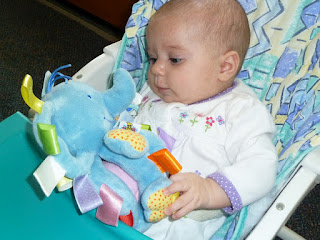
This is Eli (left, 6 months) and Kellan (right, 8 months). 


They are engaging in a form of play known as rough and tumble play.  It is not violent.  It is not agressive.  It is merely a give and take exploration of each other.  It is instinctual for a teacher to see interactions like this and stop them.  I decided to step back, not interfere, and observe the interactions.  I was standing nearby while taking pictures, ready to step in if I needed to.  I was very please that I did not need to step in.  This type of play teaches children social awareness, cooperation, fairness and altruism.  Lack of experience with this pattern of play hinders the normal give and take necessary for social mastery, and has been linked to poor control of violent impulses in later life (National Institute for Play).  I observed this first hand through these two boys that demonstrated this social give and take.

I truly hope everyone got as much out of this course as I did.  I have always known the importance of good observational skills, but this course in child development truly reinforced this knowledge. 

Saturday, April 7, 2012

Assessment in Education

Assessment is a necessity in education.  Without assessment, we cannot understand where our children are in the learning process in order to educate them appropriately.  Assessment is a set of checks and balances for student progress, teacher effectiveness, and overall classroom structure that allows for an optimum learning environment.  Assessment should be as customized as possible for each child because children all learn so differently.  Unfortunately, this is not the case.  Testing has become a game of not how smart a child is, or what they know, but of how well a teacher prepares his or her children for a test.  We are testing how well a child learns a certain way without heeding the MANY different learning styles of children. 

In the Commonwealth of Virginia, our public schools practice the Standards of Learning (SOL) system.  This is a system in which the state has standardized testing for grades 3-8 and some testing for the end of high school courses.  From the Virginia Department of Education website, I retrieved this statement: “The system [SOL testing] provides schools, school divisions and the Virginia Department of Education with critical data to inform the development and implementation of effective instructional strategies and best practices.”  Nowhere in this statement does the DOE mention the words child or learning.  I had a hard time finding these words anywhere on their website.

Ultimately, funding from the Commonwealth is dependant on how well schools perform on these tests.  Because of this, schools begin prepping their students from day one of public school life.  My co-teacher in my infant classroom used to teach 1st grade in public schools and she because so disillusioned and fed up, that this testing was one of the greatest reasons she left that job. 

Here is what she had to say about these tests:

“In order to prepare the children for these tests, the county that I taught in created assessment tests in the content areas for each grade.  So while the third graders were taking their SOL tests, all of the other grades were taking Henrico County assessment tests.  The first grade tests were multiple choice tests in Social Studies, Science, Math, and Reading.  In the areas of Social Studies and Science all of the content taught and tested was based on and built upon the content of the third grade SOL test.  From the first few weeks of school I literally had to begin teaching my children this content and model to them how to take a multiple choice test.  5 and 6 year olds.  Children who do not yet have the ability to process the several step questions that they had to answer.  Children who did not understand double negative questions.  As an adult, even I have trouble understand double negative questions.  One of the questions my children had to answer was “Which one of these is NOT a natural resource?”  Here I was trying to teach them how to take a multiple choice test and eliminate the wrong answer and I had to somehow teach this twist as well.  It was a frustrating time for me and part of the reason I made the decision to move into Early Childhood Education and work with children in a less formal setting.”

Much of the world uses this same form of testing.  When researching testing in Korean society, I was amazed at the emphasis placed on test scores.  They use a test called the College Scholastic Ability Test (CSAT) for college admissions.  Their society begins prepping children for this exam from age 4-5.  Their society revolves around this test so much that on the day of the test (the 2nd Thursday in November) government offices and public firms change their hours to reduce traffic congestion, public transportation alters its schedule to provide better for test takers, and even motorists are prohibited from honking their horns near schools.  As a result of this pressure, suicide rates for teenagers and mothers of teenagers are much higher in November and December.  Testing in America is following these patterns a little too closely for my comfort. 


References:

www.doe.virginia.gov/testing

www.korea4expats.com/article-csat-korea.html

Cindy Larsen and her blog, clynnlars.wordpress.com